 0
0
 0
0
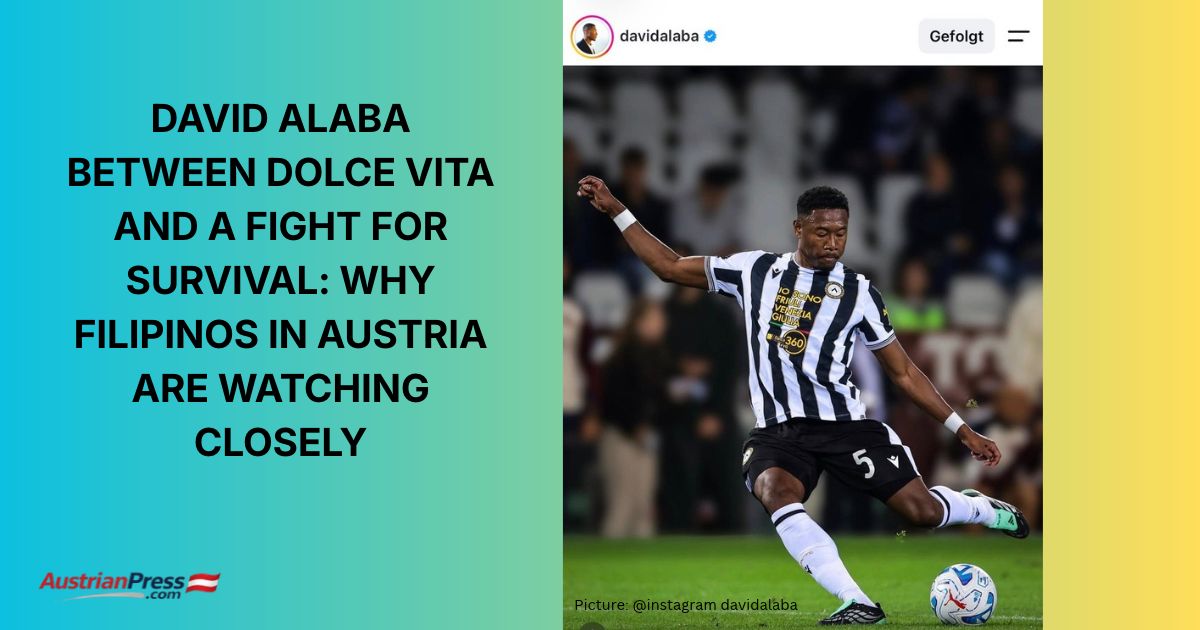
For many football fans in Austria, David Alaba’s move to Udinese marks the beginning of a new chapter. For the vibrant Filipino community in the country, however, the story carries an even deeper meaning. As the son of a Filipino mother, Gina, Alaba has long been a source of pride for Filipinos around the world, and his latest challenge in Italy has become a closely watched journey of resilience, identity, and redemption.
By all accounts, David Alaba was not expected to find himself here.
Just a few years ago, the Austrian defender was lifting trophies with Real Madrid, competing on football’s biggest stages, and cementing his status as one of Austria’s greatest-ever players. Today, the 34-year-old finds himself in a very different battle: helping Udinese escape a worrying slump in Serie A while rebuilding his own path back to top-level football.
For many Filipino families in Austria, that journey resonates far beyond football.
Alaba’s Filipino roots, through his mother Gina, have made him one of the most recognizable athletes with Filipino heritage in Europe. Throughout his glittering career at Bayern Munich, Real Madrid, and the Austrian national team, Filipino supporters have proudly followed his accomplishments. Now, after his departure from Madrid and a lengthy absence from international action, many are watching with renewed concern and anticipation.
A Club in Crisis
The timing of Alaba’s arrival in Udine could hardly be more challenging.
Udinese are under pressure after suffering four consecutive defeats, prompting alarm bells throughout the club. Reports indicate the team has entered a focused training camp ahead of a crucial home match against Lecce.
The situation is particularly difficult in attack. Injuries and fitness concerns have left coach Kosta Runjaic short of options, forcing him to improvise as he searches for answers. Yet while the offensive problems dominate headlines, attention is increasingly turning toward the defense, where Alaba could become a vital figure.
The Austrian made his competitive debut for Udinese during the recent 2-1 loss to Torino, coming off the bench for approximately 20 minutes. Despite the defeat, the appearance represented an important milestone after months without competitive action.
Italian media are already speculating that Alaba could be handed a starting role against Lecce, a sign of the faith that Runjaic has in his experienced newcomer.
The Delicate Balancing Act
Runjaic’s admiration for Alaba is no secret.
The coach reportedly would have preferred to start him earlier, but understands the need for patience after the defender’s prolonged spell without regular competitive football. The challenge now is finding the right balance between benefiting from Alaba’s leadership and protecting him from being rushed back too quickly.
For Udinese, Alaba’s experience could not come at a better time.
Few players in the squad can match a résumé that includes Champions League triumphs, Bundesliga titles, and years of international leadership. Even if he is no longer the explosive player of his twenties, his organizational skills, composure, and tactical intelligence remain valuable assets.
Those qualities may be exactly what Udinese need as they attempt to halt their downward spiral.
Austria Calling Again?
Beyond club football, another objective looms over Alaba’s comeback.
The Austrian national team remains an important target. National coach Ralf Rangnick chose not to include the then clubless captain during the most recent international window, a decision that highlighted how urgently Alaba needed regular playing time.
With upcoming Nations League fixtures on the horizon, every minute on the pitch becomes significant.
A strong performance against Lecce could strengthen his case for a return to the Austrian squad and potentially pave the way for a new chapter in his international career.
For Austrian fans, the prospect is exciting.
For Filipino-Austrian supporters, it carries special significance.
Many have grown up seeing Alaba as a symbol of multicultural success in Austria, proving that talent and hard work can transcend backgrounds and borders. His return to the national team would represent more than a football comeback; it would be another proud moment for a community that has celebrated his achievements for years.
Dolce Vita Meets Survival Battle
Away from the pressures of competition, Alaba appears to be embracing Italian life.
Social media posts have shown glimpses of a more relaxed side of his new adventure: strolls through Venice, cheerful “Buongiorno” greetings, and snapshots of everyday life in Italy. After years in Munich and Madrid, the move offers a fresh cultural experience and a chance to rediscover the simple joys of football.
Yet there is little time for sightseeing.
The reality is that Udinese need results immediately.
The club’s upcoming schedule includes a major test against AC Milan, where Alaba could potentially reunite with former Real Madrid teammate Luka Modrić. Before that challenge arrives, however, Udinese must first focus on overcoming Lecce and ending their losing streak.
A Story Filipinos Understand
Perhaps this is why so many Filipinos in Austria are following Alaba’s situation so closely.
The story is no longer simply about trophies and superstardom. It is about perseverance after setbacks, rebuilding after uncertainty, and proving oneself all over again.
These are themes that resonate strongly within migrant communities that understand the value of resilience and reinvention.
David Alaba has already conquered football’s highest peaks. What comes next may not bring the same glamour as Champions League nights in Madrid, but it could become one of the most meaningful chapters of his career.
As Udinese searches for a way out of crisis, and Austria waits to see whether its captain will return, Filipino supporters will be watching every step.
For them, David Alaba remains more than just an Austrian football star. He remains one of their own.
- Hector Pascua/picture:


This post has already been read 40 times!